
Results · Time per article
6 to 8 hours → 30 to 45 minutes
140+ articles · about 90% less time · low-budget stack: free Hugging Face hosting and a low-cost DeepSeek model
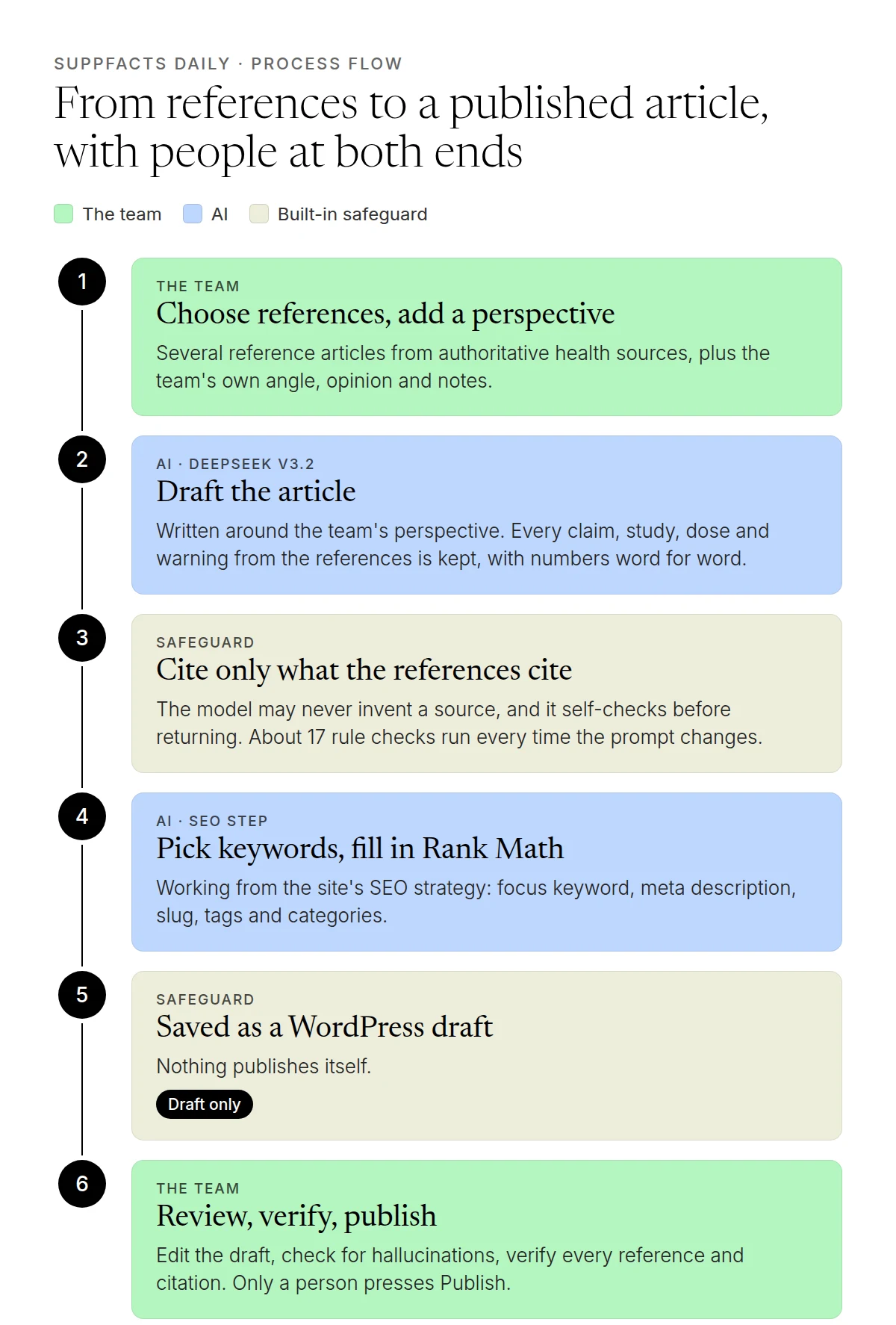
Suppfacts Daily, a health and supplement information site, needed a steady flow of well-researched articles. We built a private tool for its team. For each post, the team provides several reference articles from authoritative health sources plus its own perspective on the topic. The tool drafts the article around that perspective, cites only from the references, and saves it as a WordPress draft. Nothing publishes itself. Each article now takes about 30 to 45 minutes, down from 6 to 8 hours, a cut of about 90%. The process has been used for 140+ articles. This is part of our AI Automation work.
Faster articles, without invented facts
Suppfacts publishes supplement and health information, so a wrong dose or a made-up study does real damage. Writing every article by hand was slow: the team usually spent 6 to 8 hours on each one, because the research took time and they wrote from scratch. Unsupervised AI carried three risks:
• Dropped facts from the sources.
• Invented citations.
• US-centric advice for a readership that is not mainly American.
Drafts built around the team’s view
The first version, on 19 April 2026, was a Python pipeline. It extracts the reference content, has an AI model write the article around the team’s perspective, fetches a featured image from Unsplash, and creates a WordPress draft. The default status is draft, so nothing auto-publishes.
After testing four models, the project settled on 4 May on DeepSeek V3.2, an open-weights model called through Hugging Face’s pay-per-use inference providers.
Guardrails live in the prompt
The prompt carries four sets of rules:
• Coverage first. Every claim, study, dosage, side effect and warning in the references must appear. Numbers stay verbatim, in the same units. Coverage outranks the SEO rules.
• Citation integrity. Citations must be a subset of the sources the references themselves cite, and the model must never invent one. References render as numbered inline citations plus a sources list, and the model self-checks before returning.
• Geographic scope. No US-centric defaults, global or India-relevant examples, and no racial or ethnic generalisations in health data.
• SEO and layout. Rules for the title, opening paragraph, subheadings and image alt text, and mobile-responsive HTML.
From 21 May the pipeline also feeds the references’ own sources into the prompt. A mechanical evaluation script runs about 17 rule checks over cached outputs with no API calls, so it is free and takes seconds. It reports regressions whenever the prompt changes.
A second AI step handles the SEO. Working from the SEO strategy created for the site, it picks the focus keyword and supporting keywords for each article and writes the meta description, slug, tags and categories. The focus keyword and meta description go into the Rank Math plugin automatically.
One private page, one batch, a list of drafts
On 14 May the team got a simple private web page, a Gradio app on a free Hugging Face Space. They name a batch, add up to 20 posts (each with its references and the team’s angle, opinion and notes) and press Run. When the batch finishes, a summary email lists every draft link and attaches the run log.
Hardening followed. Streamed responses on 20 May ended timeouts on long generations (a CloudFront 504 problem). On 21 May came a multi-stage extraction fallback and a slug lookup so a server restart cannot create duplicate posts. The pipeline skips posts already published and overwrites only drafts. On 9 October the inference provider changed behind the same model, a config change.
The team then opens each draft in WordPress, tweaks the content, checks for hallucinations and verifies every reference and citation before publishing.
6 to 8 hours down to 30 to 45 minutes
• Time per article: about 30 to 45 minutes, down from 6 to 8 hours, a cut of about 90%. With the AI, every data point and its source is in front of the team when they start.
• Hours saved: more than 700, as an estimate over 140 articles. The worst case is 140 × 5.25 h = 735 h.
• Scale: 140+ articles, because the process was automated.
• Budget: kept low, with free hosting on Hugging Face and a low-cost DeepSeek model.
Common questions about this case study
Does the AI publish articles?
No. Every result is a WordPress draft. The team edits it and verifies each reference and citation before publishing.
How much time does it save?
About 30 to 45 minutes per article, against 6 to 8 hours before.
How does it avoid invented citations?
Citations must be a subset of the sources the references cite. The model self-checks, and the team verifies each citation in review.
What happens when a page cannot be read?
The pipeline falls back through several extraction stages. Some pages still resist it, so the human check matters.